
Case study · · By Faisal Ali
Amazon FBA Supply Chain Case Study: How a Million-Dollar Socks Brand Cut Lead Time by 60 Days and Freed $400K
In its first supply chain cycle with TheBrandSpur, a million-dollar Amazon socks brand dropped its costly US warehouse stop and began shipping straight into Amazon. Lead time fell by 60 days, and about $400K of cash came out of inventory.
- Lead time, down from 180
- 120 days
- Cash freed from inventory
- $400K
- Lower freight cost
- 19%
- Inbound placement fees in two years
- $0
“Since TheBrandSpur took over our supply chain, our COGS have come down and our cash flow is stronger than ever. Just as important, supply chain is no longer something I lose sleep over. That peace of mind, and the profit it has added to the business, is why I see TBS as a true partner, not just a service provider.”
— CEO, million-dollar Amazon socks brand
Results at a glance
| Metric | Before | After |
|---|---|---|
| Lead time (PO placement to FBA stock availability) | 180 days | 120 days |
| Freight cost | Baseline | About 19% lower |
| Air freight | Needed every Q4 | None since onboarding |
| Inbound placement fees | Charged per shipment | $0 for two years |
| Storage of excess stock | Full POs held in a paid US 3PL | Held free at the supplier for 30 days, saving about $18K a year on average |
| On-hand inventory | Extra stock to cover long lead times | 60 days less, freeing about $400K |
| Freight payment terms | Paid at ETD (estimated time of departure) | Net 15 after delivery |
The new model was live within the first supply chain cycle. It now runs on ShipSpur ERP, TheBrandSpur's own supply chain platform.
The client
A million-dollar seller on Amazon US, this apparel brand runs more than 1,000 active SKUs, because every sock style comes in several sizes. Its socks are made by suppliers in China and fulfilled through FBA (Fulfillment by Amazon).
- Industry: Apparel (socks)
- Marketplace: Amazon US
- Catalog: 1,000+ active SKUs (each style in multiple sizes)
- Sourcing: China-based suppliers
- Services: Supply chain management, freight procurement, Amazon inbound and inventory management
The challenge
The brand was paying twice for every unit: once to store it in the US, and again in cash tied up in extra inventory.
At onboarding, each full PO (purchase order) shipped from China to a 3PL (third-party logistics) warehouse in the USA. The team then created Amazon shipments from there as stock was needed. That model caused three problems:
- Long lead times. The extra stop stretched the journey to about 180 days from PO placement to stock being available in FBA. In Q4, the brand had to fall back on costly air freight to stay in stock.
- High US storage costs. Whole POs sat in a paid 3PL instead of moving straight into Amazon's network.
- Cash locked in inventory. Long lead times meant holding more safety stock, and more working capital to fund it.
Before and after
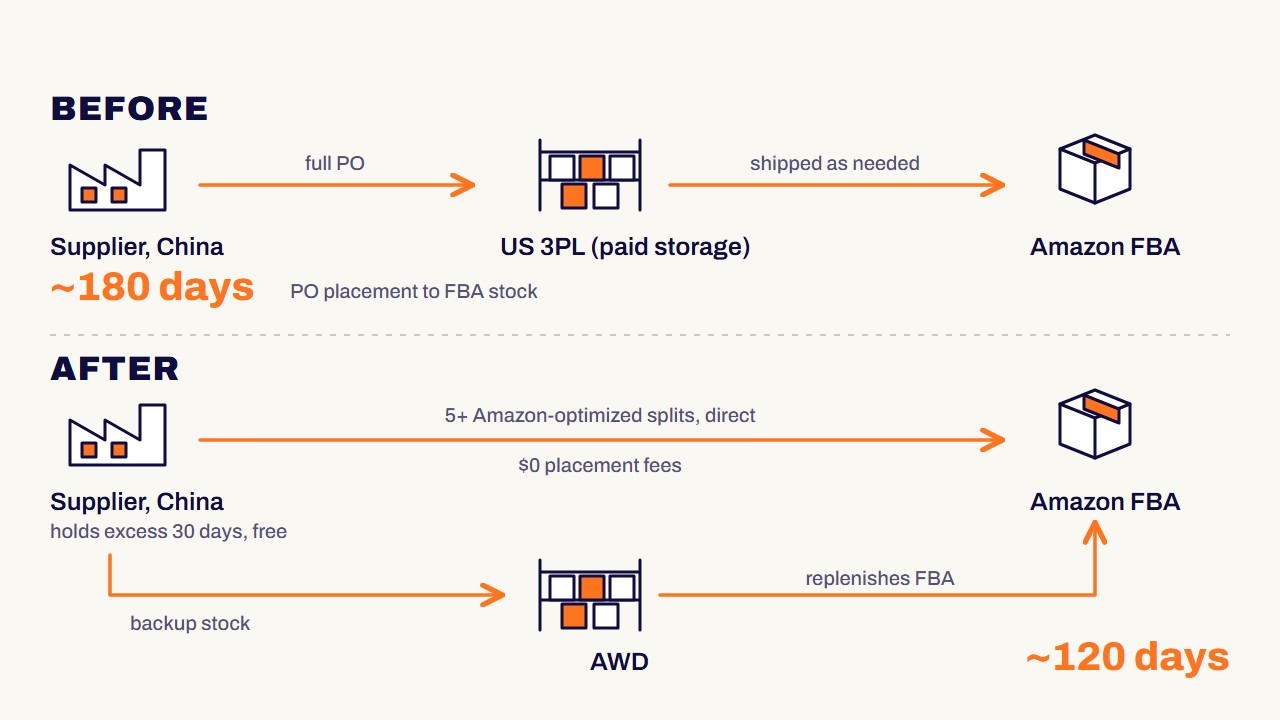
The new shipping model, step by step
- PO ready. The supplier finishes production.
- Shipment confirmed. We decide what ships now, based on Amazon demand and stock cover.
- Excess held at source. Units not needed yet stay with the supplier for up to 30 days, free of charge.
- Freight quotes compared. Several freight forwarders quote, and we book on service level and price.
- Five splits direct to Amazon. Each shipment goes straight to FBA, divided across five or more Amazon locations.
- Backup stock to AWD. Buffer inventory goes to AWD (Amazon Warehousing and Distribution, Amazon's lower-cost bulk storage) instead of a US 3PL.
- AWD replenishes FBA. Stock moves from AWD into FBA as it sells.
- Reconciliation. Every shipment is checked against what Amazon received.
How we did it
1. Renegotiated with suppliers
We convinced suppliers to ship POs in batches instead of all at once, and to hold the remaining goods for 30 days at no cost. That removed the need for a US 3PL.
2. Five splits on every shipment
Amazon charges an inbound placement fee on every unit unless the seller chooses Amazon-optimized splits, which send a shipment to five or more Amazon locations. That option is only available when each SKU ships in at least five identical cartons. Even across more than 1,000 active SKUs, the brand's supplier orders are large enough that every SKU clears that bar, so every shipment goes out as Amazon-optimized splits and the brand pays no placement fee at all.
3. Competitive freight quotes
We widened the panel of freight forwarders and set up a fair quote process: several forwarders quote on each shipment, and we award it on service level and price. Combined with the new model, this cut freight costs by about 19%. With planned, batched sea shipments, the brand hasn't needed a single air shipment since onboarding, even in Q4.
4. Better terms with forwarders
- Net 15 after delivery, instead of paying at ETD (estimated time of departure), so the brand keeps its cash through the whole transit.
- Duties paid on customs clearance, not before.
- Forwarders pay for their own mistakes: any Amazon defect fees caused by a forwarder are deducted from its freight invoice.
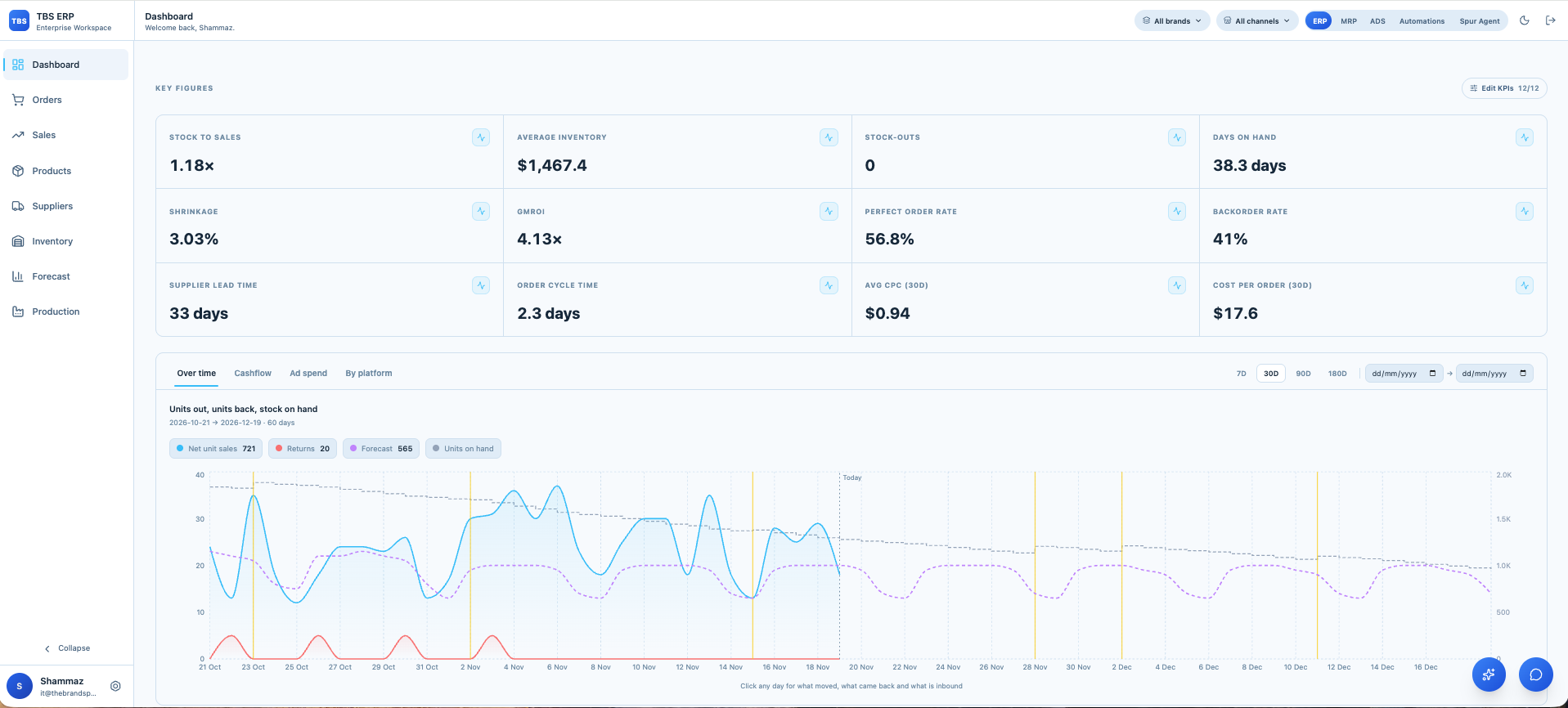
5. ShipSpur ERP: the whole supply chain on one page
TheBrandSpur developed and implemented ShipSpur ERP in 2026. It shows every stage, from PO to reconciliation, on a single page. Reports pull live data from the Amazon API, and third-party data flows in from Google Sheets trackers, so the team sees shipments, inventory, costs and claims for all 1,000+ SKUs in one place without manual reporting.
What it meant for the business
The brand no longer scrambles to stay in stock every Q4, and its money works harder: far less of it sits in inventory or in freight bills paid weeks before goods arrive. Lower COGS has flowed straight into profit, and the CEO now spends time growing the brand instead of chasing shipments.